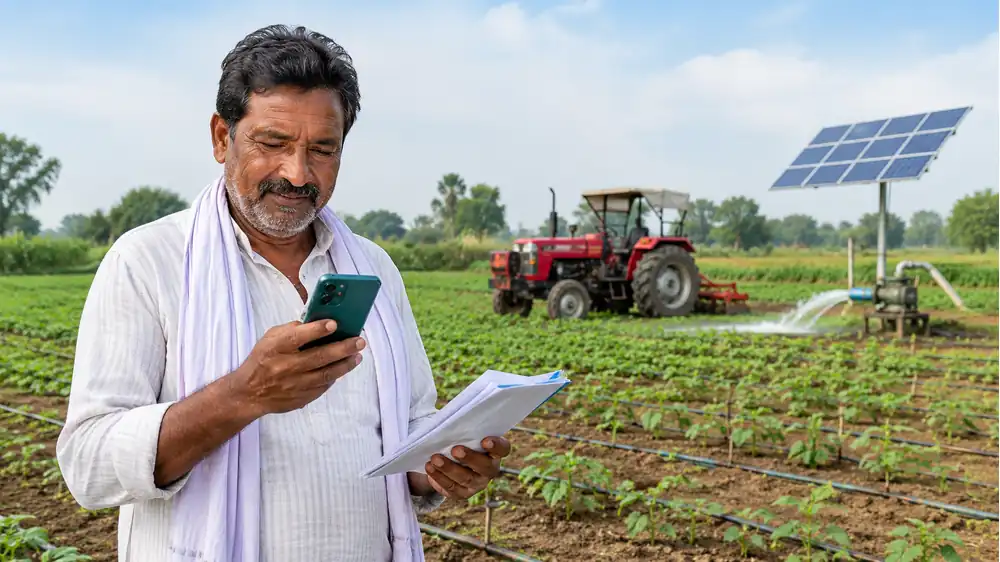
The cost of seeds, fertilisers, irrigation, machinery, electricity, crop protection products and new technology is continuously increasing. As a result, many farmers wonder how they can reduce farming costs and increase their income.
The government regularly runs several agriculture subsidy schemes to support farmers. However, due to a lack of information, many farmers are unable to benefit from these schemes.
Many farmers remain busy with cultivation and selling their produce, but they may not know that the government provides financial assistance to reduce the cost of farming.
Let us understand which subsidies farmers may receive and what they should do to benefit from them.
What Is an Agriculture Subsidy?
An agriculture subsidy is financial assistance provided by the government to farmers so that farming costs can be reduced and modern agricultural methods can be adopted.
The government provides support in different areas, such as:
- Assistance for purchasing agricultural machinery
- Subsidies on irrigation equipment
- Support for seeds and agricultural materials
- Grants for installing solar pumps
- Assistance for drip and sprinkler irrigation
- Support for horticulture and adopting new farming technologies
The purpose of a subsidy is to reduce the farmer’s cost and increase agricultural production.
Major Agriculture Subsidy Schemes for Farmers
1. Farm Machinery Subsidy
The use of tractors, rotavators, seed drills, harvesters and other machines is increasing in farming.
Through agricultural mechanisation schemes, the government provides financial assistance to farmers for purchasing machinery.
This can help farmers:
- Reduce labour costs
- Complete farming activities on time
- Increase production capacity
This assistance can be particularly useful for small and marginal farmers.
2. Pradhan Mantri Krishi Sinchayee Yojana (PMKSY)
Water is one of the most important requirements for farming. However, many areas face irrigation problems.
Under the Pradhan Mantri Krishi Sinchayee Yojana, farmers may receive assistance for water-saving technologies such as:
- Drip irrigation
- Sprinkler irrigation
These systems can help with:
- Saving water
- Better use of fertilisers
- Improvement in crop production
3. Subsidy on Solar Pumps
The cost of electricity and diesel is a major concern for farmers.
The government provides assistance to farmers for installing solar pumps.
Solar pumps can help farmers:
- Reduce irrigation costs
- Reduce dependence on electricity
- Save money in the long term
4. Assistance for Seeds and Agricultural Materials
In many states, farmers receive assistance for certified seeds, planting material and other agricultural inputs.
Good-quality seeds can:
- Provide better germination
- Increase production capacity
- Reduce the risk of diseases
Farmers should contact their state agriculture department or the nearest Krishi Vigyan Kendra (KVK) for information.
5. Subsidy for Horticulture and New Farming Methods
Farmers who want to grow fruits, vegetables, flowers or other high-value crops may receive assistance through various schemes.
Support may be available for:
- Fruit-bearing plants
- Polyhouses or shade nets
- Protected cultivation
- Horticulture development
How Can Farmers Apply for a Subsidy?
The subsidy application process may differ according to the state and the scheme. The general process is as follows:
1. Collect Information About the Scheme
First, find out which agriculture subsidies are available in your state.
For information, contact:
- Agriculture department office
- Krishi Vigyan Kendra (KVK)
- Kisan Seva Kendra
- State agriculture portal
2. Keep the Required Documents Ready
The following documents may usually be required:
- Aadhaar card
- Bank passbook
- Land documents, such as Khasra or Khatauni
- Mobile number
- Passport-size photograph
- Farmer registration, wherever applicable
Please note that the required documents may vary according to the scheme.
3. Submit the Application
Applications for many schemes can be submitted:
- Through an online portal
- At the agriculture department office
- Through authorised centres
What Mistakes Do Farmers Commonly Make?
Many farmers are unable to receive subsidies because of the following reasons:
They Do Not Get Information on Time
Many schemes have a limited application period.
They Depend Only on Other People
Farmers should also collect information about schemes themselves.
They Submit Incorrect Documents
Mistakes in documents can delay or stop the application.
They Become Dependent on Middlemen
Avoid paying money to any unauthorised person for a government scheme.
Does Every Farmer Receive a Subsidy?
No. Every scheme has its own eligibility conditions.
Eligibility may depend on:
- The farmer’s category
- The size of the landholding
- State rules
- The scheme’s budget
- Available targets
Therefore, farmers should check the eligibility conditions before applying.
The Most Important Advice for Farmers
To reduce farming costs, farmers should not focus only on crop production. They should also check which government schemes are available to support them.
An informed farmer:
- Applies at the right time
- Keeps track of government schemes
- Adopts new technology
- Reduces farming costs
Conclusion
Agriculture subsidies are an important way for farmers to reduce the cost of farming. Schemes related to machinery, irrigation, solar pumps, seeds and modern farming technologies can provide valuable support.
Farmers who have not yet applied for any government agriculture subsidy should contact their nearest agriculture department office or Krishi Vigyan Kendra for information.
An informed farmer is an empowered farmer.
Kishanix is always with you in bringing the right information to farmers.
Frequently Asked Questions
1. What is an agriculture subsidy?
An agriculture subsidy is financial assistance provided by the government to farmers to reduce the cost of farming.
2. Which items usually receive the highest subsidy?
This varies according to the state and the scheme. Assistance is commonly available for agricultural machinery, irrigation equipment, solar pumps and horticulture.
3. Where can farmers apply for government subsidies?
Farmers can obtain information and apply through their state agriculture department portal, agriculture office or Krishi Vigyan Kendra.
4. Can small farmers also receive subsidies?
Yes. Many schemes give priority to small and marginal farmers.
5. How long does it take to receive a subsidy?
The time required depends on the scheme, the state and the application process.